- Watch Reporter
- Posts
- Patek Philippe 3940: Next Million Dollar Watch
Patek Philippe 3940: Next Million Dollar Watch

Watch Reporter
May 15, 2026

The Patek Philippe 3940: Why the “Blue-Chip Patek” Could Become a $1 Million Watch
There are watches that are collectible.
There are watches that are historically important.
And then there are watches that become foundational assets in the world of collecting.
The Patek Philippe Reference 3940 is increasingly becoming exactly that: the blue-chip cornerstone of modern Patek Philippe collecting.
For years, the market overlooked the 3940. Collectors chased steel sports watches, Nautilus hype, and short-term speculation. Meanwhile, a small group of sophisticated collectors quietly accumulated one of the most important perpetual calendars ever made.
We discussed this watch 5 years ago around the $50,000 level.

Today, the market is finally waking up.
At the recent Geneva auctions, a Patek Philippe 3940G crossed approximately $110,000 — an important milestone because standard-production white gold 3940s were trading dramatically lower only a few years ago. The Geneva sales overall were exceptionally strong, with Christie’s reporting record totals and extremely high sell-through rates, confirming continued institutional demand for historically important Patek Philippe references.
And we believe this move is still in its early stages.
Within several years, we believe strong examples could approach $250,000. Over the next 15–20 years, even standard yellow gold and white gold 3940s could potentially approach the $1 million level.
That sounds extreme today.
But in the 1990s, Andy Warhol dollar-sign paintings could be purchased for roughly $20,000. Today, comparable works trade for several million dollars. The same pattern repeats throughout collectible history: assets that later become culturally foundational always look “expensive” right before they become generational.
Why the 3940 Matters
The 3940 is not just another Patek Philippe.
It represents a turning point in modern horological history.
Released in 1985 in the aftermath of the Quartz Crisis, the 3940 symbolized the rebirth of elite Swiss mechanical watchmaking.
At a time when many believed quartz technology would permanently replace traditional watchmaking, Patek Philippe responded with something radically different: an ultra-thin perpetual calendar powered by the legendary micro-rotor caliber 240Q.
Today, collectors increasingly recognize the 3940 as one of the foundational references that helped restore mechanical watchmaking’s prestige.
Even Philippe Stern himself famously wore the 3940 as his personal watch — an extraordinary statement considering he could have worn virtually any Patek Philippe ever produced.
The Ultimate “Pure” Patek
The brilliance of the 3940 is restraint.
Unlike modern oversized complications, the 3940 is elegant, thin, understated, and timeless. At approximately 36mm, it wears with extraordinary sophistication.
It does not scream wealth.
It whispers taste.
The dial layout remains one of the cleanest perpetual calendar executions ever designed:
Day
Date
Month
Moonphase
Leap year
24-hour display
Everything is perfectly balanced.
No excess. No clutter. No gimmicks.
Just pure Patek Philippe design language at its peak.
Many collectors increasingly view the 3940 as the last truly classical perpetual calendar before the luxury watch market became dominated by hype cycles, oversized cases, celebrity culture, and social-media-driven trends.
Rare — But Liquid
What makes the 3940 especially fascinating from an investment perspective is the balance between rarity and liquidity.
Most collectible watches fail as long-term investment assets because they fall into one of four categories:
Too common
Too obscure
Too trendy
Too illiquid
The 3940 avoids all four problems.
Across all metals — yellow gold, white gold, rose gold, and platinum — estimates suggest approximately 6,000 examples were produced over more than 20 years. (acollectedman.com)
That sounds like a large number.
It isn’t.
Spread across two decades and four metals, production likely averaged only several hundred watches annually worldwide.
That creates the perfect collector dynamic:
Rare enough to remain exclusive
Common enough that the market understands it
Enough examples to establish auction comparables
Enough market activity to create liquidity and pricing transparency
Enough collector awareness to become globally recognized
This is exactly what creates blue-chip collectible markets.
The same dynamic occurred with:
Ferrari Daytonas
Early Porsche RS models
Certain vintage Rolex Daytonas
Warhol works
Picasso prints
The market first dismisses them as “too expensive.”
Then later realizes they were actually scarce cultural assets.
That is the sweet spot.
And the 3940 sits directly inside it.
The Gilt Dial 3940 Already Set the Benchmark
Importantly, the market has already given us a preview of where exceptional 3940s can go.

Rare gilt-dial examples of the Patek Philippe 3940 — particularly the coveted Beyer-signed pieces with warm golden dials — have already entered an entirely different valuation category. Collectors increasingly view these watches not merely as perpetual calendars, but as museum-level transitional references linking vintage Patek Philippe aesthetics with modern mechanical watchmaking.
In fact, rare gilt-dial 3940s have already approached the seven-figure conversation in the collector market, establishing an important psychological precedent for the broader reference family.
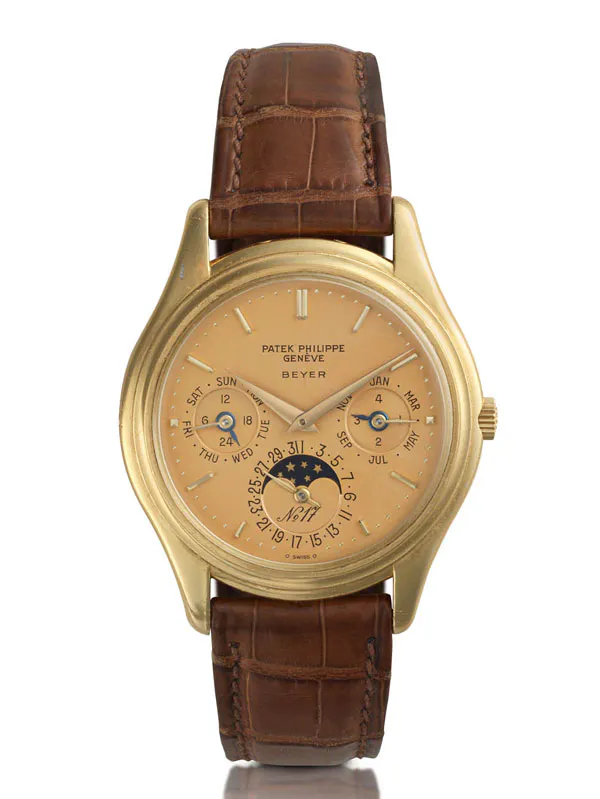
That matters enormously.
Because once a collector category establishes a top-end benchmark, the rest of the reference family often reprices upward behind it.
The Market Is Reclassifying the 3940
What makes the recent Geneva auction result so important is not merely the price itself.
It is what the price represents psychologically.
For years, the 3940 occupied an awkward space in the market:
too expensive for casual buyers,
too classical for hype collectors,
and too modern for vintage purists.
That is often exactly the setup that precedes major long-term repricing cycles.
Now the market is beginning to see the watch differently.
Not as:
“an older perpetual calendar dress watch.”
But as:
“one of the foundational references that helped resurrect elite Swiss mechanical watchmaking after the Quartz Crisis.”
That transition changes everything.
Historically, when collectors collectively reclassify an object from:
“nice collectible”
to
“culturally foundational asset,”
prices can rise for decades.
Why Prices Are Rising Now
For years, the 3940 remained overshadowed by steel sports-watch mania.
But the collector market is evolving.
Sophisticated buyers are increasingly shifting away from hype and toward historically important watches with genuine scarcity, timeless aesthetics, and institutional significance.
The 3940 checks every box:
Historically important
Elegant and timeless
Produced in relatively small numbers
Legendary movement
Highly wearable
Strong auction history
Deep collector recognition
Increasing institutional respect among serious collectors
Most importantly, supply is disappearing into long-term collections.
Many 3940 owners are not flippers. These are seasoned collectors who understand exactly what the watch represents historically.
As more examples disappear into permanent collections, supply tightens further.
That is how exponential repricing cycles begin.
The Blue-Chip Patek
The market is starting to understand something very important:
The 3940 is no longer simply a “vintage perpetual calendar.”
It is being reclassified.
From:
“used complicated dress watch”
To:
“foundational blue-chip Patek Philippe reference.”
That transition changes everything.
Because once collectors collectively recognize an object as culturally foundational, the market often reprices dramatically over long periods of time.
The 3940 may ultimately become the defining perpetual calendar of the late 20th century.
Not because it is flashy.
Not because celebrities wear it.
But because it represents the exact moment mechanical watchmaking reclaimed its soul after the Quartz Crisis.
It is understated greatness.
And historically, understated greatness becomes very expensive.